Why LLM Gateways Matter Once AI Apps Reach Production
Learn why LLM gateways become essential for routing, reliability, observability, and provider independence in production AI systems.
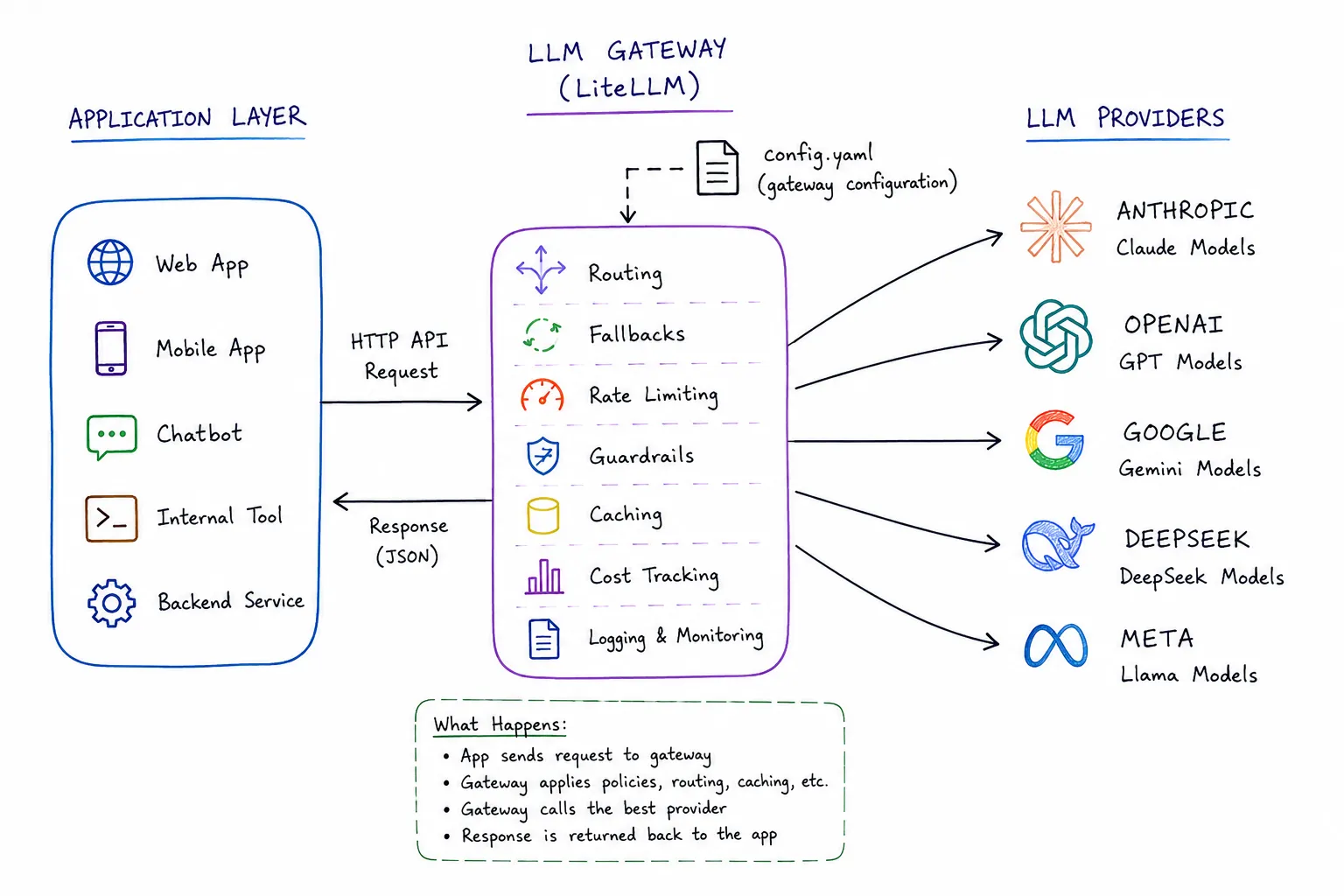
Everyone talks about building AI applications. Very few people talk about what happens after those applications start serving real users.
At first, the architecture looks deceptively simple: your backend sends a request to an LLM provider and returns the response. A single SDK, a few API keys, and you’re done. At least that’s what I thought.
Then production arrives, and suddenly the clean architecture starts accumulating responsibilities that have nothing to do with your actual product.
The Hidden Complexity of Production AI
The moment traffic increases, new requirements begin showing up from every direction.
You need retries because providers occasionally fail. You need rate limiting because quotas get exhausted. You need logging because debugging AI behavior without visibility is almost impossible. Then someone asks for cost tracking, and now you’re storing token usage metrics across requests.
Before long, your backend starts handling concerns like:
- Provider failover
- Request retries
- Response caching
- Cost monitoring
- Rate limiting
- Request tracing
- Model routing
- Usage analytics
None of these features directly contribute to your product’s business logic. They’re infrastructure concerns, yet they slowly become tightly coupled to application code.
The SDK Explosion Problem
The situation gets worse when multiple models enter the picture.
Maybe you’re using GPT-4o for reasoning-heavy tasks, Claude for coding workflows, and a cheaper model for simple classification or extraction jobs.
Now your backend starts looking like this:
if (task === "reasoning") {
  return openai.chat.completions.create(...)
}

if (task === "coding") {
  return anthropic.messages.create(...)
}

if (task === "classification") {
  return deepseek.chat.completions.create(...)
}
Provider-specific SDKs begin spreading across the codebase. Routing logic appears in services. Fallback logic gets duplicated. Every new provider introduces more integration work.
The application gradually becomes tightly coupled to model vendors.
Enter LLM Gateways
This is the exact problem LLM gateways are designed to solve.
Instead of connecting your application directly to every provider, you introduce a centralized layer between them.
Traditional architecture:
Backend → OpenAI
Backend → Claude
Backend → Gemini
Gateway architecture:
Backend → LLM Gateway → ProvidersThe gateway becomes the single entry point for all model communication.
Your application no longer cares whether a request is ultimately handled by OpenAI, Anthropic, Gemini, or any future provider. It simply sends requests to the gateway.
One API, Multiple Providers
What I find interesting is how much complexity disappears from application code.
Instead of maintaining multiple SDK integrations, the application only needs a single interface:
POST /chat/completionsThe gateway handles everything else behind the scenes.
This abstraction feels very similar to how API gateways evolved in distributed systems. Services stopped caring about authentication, routing, observability, and rate limiting because those concerns were centralized.
The same pattern is now emerging for AI infrastructure.
What the Gateway Actually Handles
A modern LLM gateway typically manages several operational concerns automatically.
Provider Routing
Different models excel at different tasks.
You might route:
GPT-4ofor complex reasoningClaudefor code generationDeepSeekfor cost-sensitive inference- Smaller models for classification
The application doesn’t need to know these decisions. Routing rules live in configuration instead of business logic.
Automatic Fallbacks
Provider outages are inevitable.
The question isn’t whether a provider will fail. The question is whether your application can recover without users noticing.
If a primary provider becomes unavailable or exceeds rate limits, the gateway can automatically redirect traffic to a backup model.
Without a gateway, this logic usually gets duplicated across services and endpoints.
Caching and Rate Limiting
AI requests are expensive.
Caching repeated prompts can significantly reduce costs while improving latency. Similarly, centralized rate limiting prevents runaway usage and protects provider quotas.
Handling these concerns at the gateway layer creates a single enforcement point instead of scattering implementation across services.
Observability and Cost Tracking
One of the biggest challenges in AI systems is understanding what’s happening in production.
Questions like:
- Which model is generating the highest costs?
- Which provider is failing most frequently?
- What is the average latency per model?
- How many tokens are being consumed daily?
become much easier to answer when every request passes through a centralized gateway.
Instead of collecting metrics from multiple SDKs and providers, you get a unified view of the entire AI stack.
Why LiteLLM Made This Click For Me
I’ve been experimenting with LiteLLM locally, and it made the architecture much easier to understand.
What stood out wasn’t the ability to connect multiple providers. Plenty of libraries already do that.
The interesting part was realizing that the application itself doesn’t need to know anything about provider-specific implementations.
The backend simply talks to the gateway, and the gateway decides where requests should go.
That separation creates a cleaner boundary between product code and infrastructure code.
Swapping Providers Without Code Changes
This is probably the biggest advantage.
If model selection is defined in configuration, switching providers becomes an operational decision instead of an engineering project.
You can update routing rules, introduce new models, or replace providers without touching backend services.
The application continues sending requests to the same endpoint while the infrastructure evolves underneath.
For teams working in a rapidly changing AI ecosystem, that flexibility is incredibly valuable.
AI Infrastructure Is Becoming a Platform Layer
The more I look at modern AI systems, the more they resemble patterns we’ve already seen in distributed systems.
We introduced API gateways because service-to-service communication became complex.
We introduced service meshes because networking concerns became difficult to manage.
Now we’re introducing LLM gateways because model management is becoming operationally complex.
The models may be new, but the architectural lesson isn’t.
As AI applications mature, we’re starting to see the emergence of a dedicated platform engineering layer for AI infrastructure. LLM gateways sit at the center of that evolution.
They don’t make models smarter. They make systems easier to operate.
And once an AI application reaches production, that distinction matters a lot more than most people expect.