Inside PostgreSQL Autovacuum: Dead Tuples, Thresholds, and Production Tuning
Understand how PostgreSQL autovacuum decides when to run, how it prevents table bloat, and how to tune it safely in production.
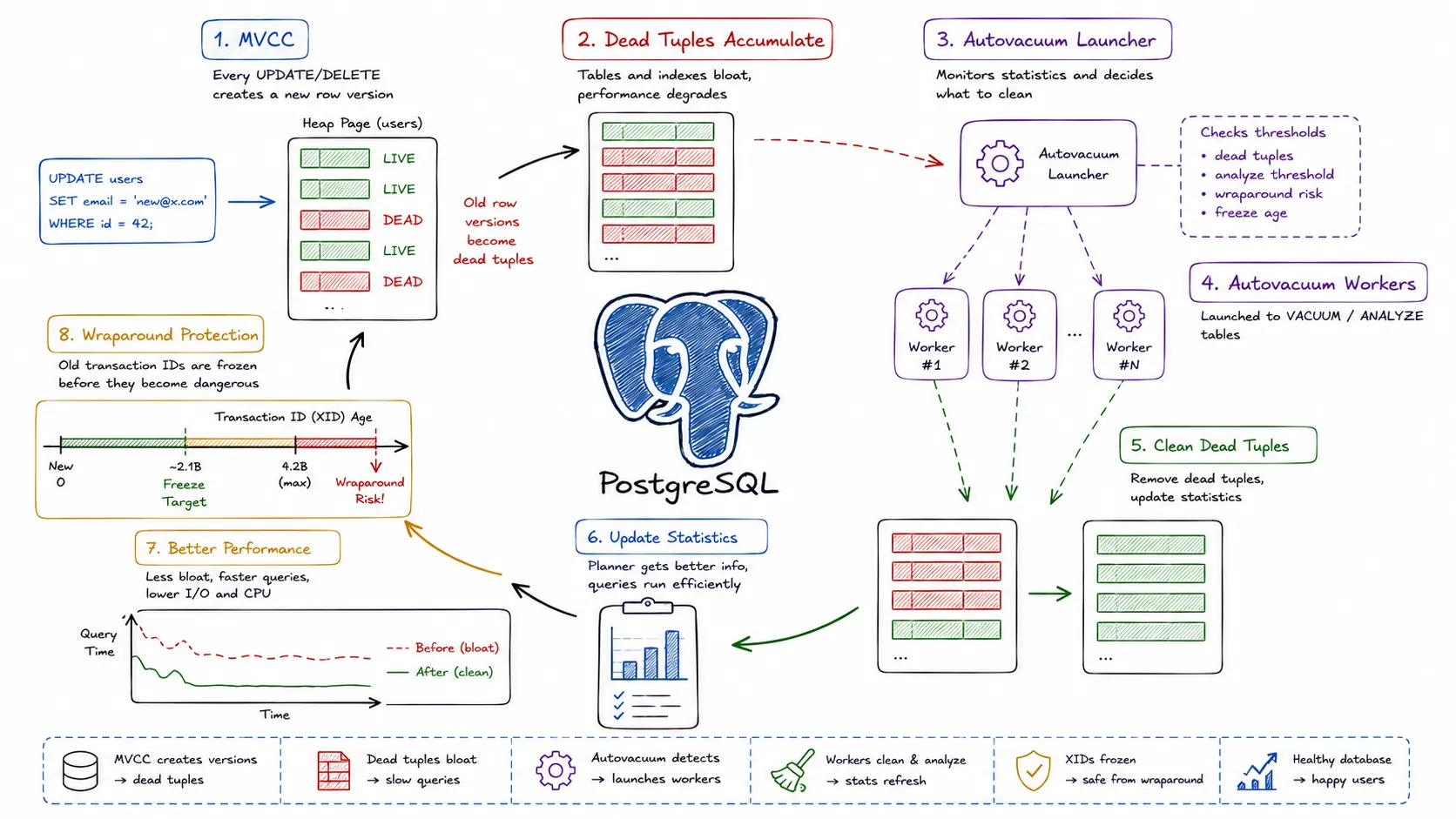
Every PostgreSQL database eventually accumulates dead rows. Every UPDATE creates a new row version, every DELETE leaves space behind, and without cleanup performance slowly degrades. That’s where autovacuum comes in. It’s one of PostgreSQL’s most important background systems, yet it’s often blamed whenever a query becomes slow. In reality, autovacuum is usually fixing problems rather than causing them.
Why PostgreSQL Needs Autovacuum
To understand autovacuum, I first need to revisit MVCC (Multi-Version Concurrency Control).
In PostgreSQL, an UPDATE doesn’t modify a row in place. Instead, PostgreSQL creates a new version of the row and marks the old version as obsolete. Similarly, a DELETE doesn’t immediately remove data from disk. The old tuple remains until PostgreSQL determines it is no longer visible to any transaction.
This behavior allows readers and writers to operate concurrently without blocking each other, but it introduces a new problem: dead tuples accumulate over time.
UPDATE users
SET email = 'new@example.com'
WHERE id = 42;
After this statement:
- A new row version is created
- The previous version becomes dead
- Disk space is not immediately reclaimed
As updates continue, tables grow larger than necessary.
MVCC gives PostgreSQL excellent concurrency, but it requires a cleanup mechanism to remove obsolete row versions.

Without cleanup:
- Sequential scans read more pages
- Indexes become larger
- Cache efficiency drops
- Query latency increases
- Storage consumption grows
Autovacuum exists primarily to prevent these issues.
What Autovacuum Actually Does
Many people assume autovacuum simply runs VACUUM periodically. The reality is more sophisticated.
Autovacuum is a collection of background workers managed by the autovacuum launcher. The launcher continuously evaluates database statistics and decides which tables need maintenance.
Its primary responsibilities are:
- Removing dead tuples
- Updating table statistics
- Preventing transaction ID wraparound
- Helping reclaim reusable space
Internally, the process looks roughly like this:
- PostgreSQL tracks tuple activity
- Statistics are updated
- Thresholds are evaluated
- Autovacuum workers are launched
- Dead tuples are cleaned
The launcher doesn’t clean tables itself. Instead, it schedules worker processes that perform the actual maintenance.

A common misconception is that autovacuum shrinks tables. Standard VACUUM usually does not reduce file size. It merely marks space as reusable for future inserts and updates.
This distinction is important because reclaiming disk space and reusing space are different goals.
How PostgreSQL Decides When to Run
The most important autovacuum question is simple:
When does PostgreSQL decide a table needs vacuuming?
The decision is based on a threshold formula.
For vacuuming:
vacuum threshold =
autovacuum_vacuum_threshold +
(autovacuum_vacuum_scale_factor × table_row_count)
Default values are:
autovacuum_vacuum_threshold = 50
autovacuum_vacuum_scale_factor = 0.2
Imagine a table containing 1,000,000 rows.
50 + (0.2 × 1,000,000)
= 200,050 dead tuples
Autovacuum starts only after approximately 200,050 dead tuples accumulate.
For large tables, this can be surprisingly late.
Consider a table that receives heavy updates all day. Waiting for 20% of the table to become dead can create significant bloat before cleanup begins.
Large production tables often require lower scale factors than PostgreSQL defaults.

Statistics collection uses a similar mechanism:
autovacuum_analyze_threshold
autovacuum_analyze_scale_factor
When enough rows change, PostgreSQL triggers ANALYZE so the planner can generate accurate execution plans.
The Transaction ID Wraparound Problem
Autovacuum is not only about performance. It is also a critical safety mechanism.
Every transaction receives a transaction ID stored internally as XID.
Transaction IDs are finite:
0 → 4,294,967,295Eventually they wrap around.
If PostgreSQL allowed old transaction IDs to remain indefinitely, visibility rules would break and data corruption could occur.
To prevent this, PostgreSQL periodically freezes old tuples.
Internally, frozen tuples no longer depend on ancient transaction IDs for visibility checks.
You can inspect table age with:
SELECT
    relname,
    age(relfrozenxid)
FROM pg_class
ORDER BY age(relfrozenxid) DESC;
When transaction age becomes dangerous, PostgreSQL launches aggressive vacuum operations regardless of normal thresholds.
Wraparound protection is one of the few maintenance tasks PostgreSQL will prioritize over performance concerns.

Disabling autovacuum can eventually make a database refuse write operations to protect itself from wraparound risk.
Why Autovacuum Gets Blamed Unfairly
Autovacuum often appears in monitoring dashboards at exactly the moment performance problems become visible.
Because of this timing, it frequently becomes the suspected culprit.
In reality, autovacuum is usually responding to a workload problem that already exists.
For example:
- An application performs massive updates
- Dead tuples accumulate
- Table bloat grows
- Query performance degrades
- Autovacuum finally starts
- Engineers notice the worker process
The workload created the problem. Autovacuum merely showed up to clean the mess.
There are cases where autovacuum contributes to resource pressure:
- High I/O usage
- Increased disk reads
- CPU consumption
- Buffer cache churn
However, these costs are generally lower than the long-term cost of skipping maintenance.
A useful diagnostic query is:
SELECT
    relname,
    n_live_tup,
    n_dead_tup,
    last_autovacuum
FROM pg_stat_user_tables
ORDER BY n_dead_tup DESC;
When I see massive dead tuple counts, my first question is rarely “Why is autovacuum running?” Instead, it’s usually “Why did this table generate so many dead rows?”
Practical Autovacuum Tuning
The default configuration is intentionally conservative because PostgreSQL must work for many different workloads.
Production systems often benefit from table-specific tuning.
For heavily updated tables, I commonly lower the scale factor.
Example:
ALTER TABLE orders
SET (
    autovacuum_vacuum_scale_factor = 0.02
);
Now vacuum starts after roughly 2% dead tuples instead of 20%.
For write-heavy systems, useful settings include:
autovacuum_max_workers = 6
autovacuum_naptime = 30s
autovacuum_vacuum_cost_limit = 4000
The correct values depend on:
- Table size
- Update frequency
- Storage performance
- Available CPU
- Available I/O bandwidth

Blindly increasing worker counts can create unnecessary contention. Blindly reducing them can allow bloat to grow unchecked.
The best tuning approach is always driven by metrics:
pg_stat_user_tablespg_stat_progress_vacuumpg_stat_all_tables- Dead tuple growth rate
- Query latency trends
Autovacuum tuning is ultimately a balancing act between maintenance cost and long-term database health.
Final Thoughts
Autovacuum is one of PostgreSQL’s most important background systems because it enables MVCC to remain practical at scale. Without it, dead tuples accumulate, statistics become stale, transaction IDs age dangerously, and performance steadily degrades.
The key lesson is that autovacuum is usually a symptom observer, not the root cause of a problem. When I see autovacuum working hard, I investigate why so many dead tuples are being created rather than trying to disable the cleanup process.
Understanding the threshold formulas, wraparound protection, worker architecture, and tuning options makes autovacuum far less mysterious. Once viewed through PostgreSQL internals, it becomes clear that autovacuum is not the enemy of performance—it’s one of the systems protecting it.