Beyond B-Tree: When to Use GIN, GiST, and BRIN Indexes in PostgreSQL
Discover how PostgreSQL's specialized index types, GIN, GiST, and BRIN - accelerate full-text search, geospatial queries, JSONB lookups, and massive time-series datasets far beyond what traditional B-Tree indexes can handle.
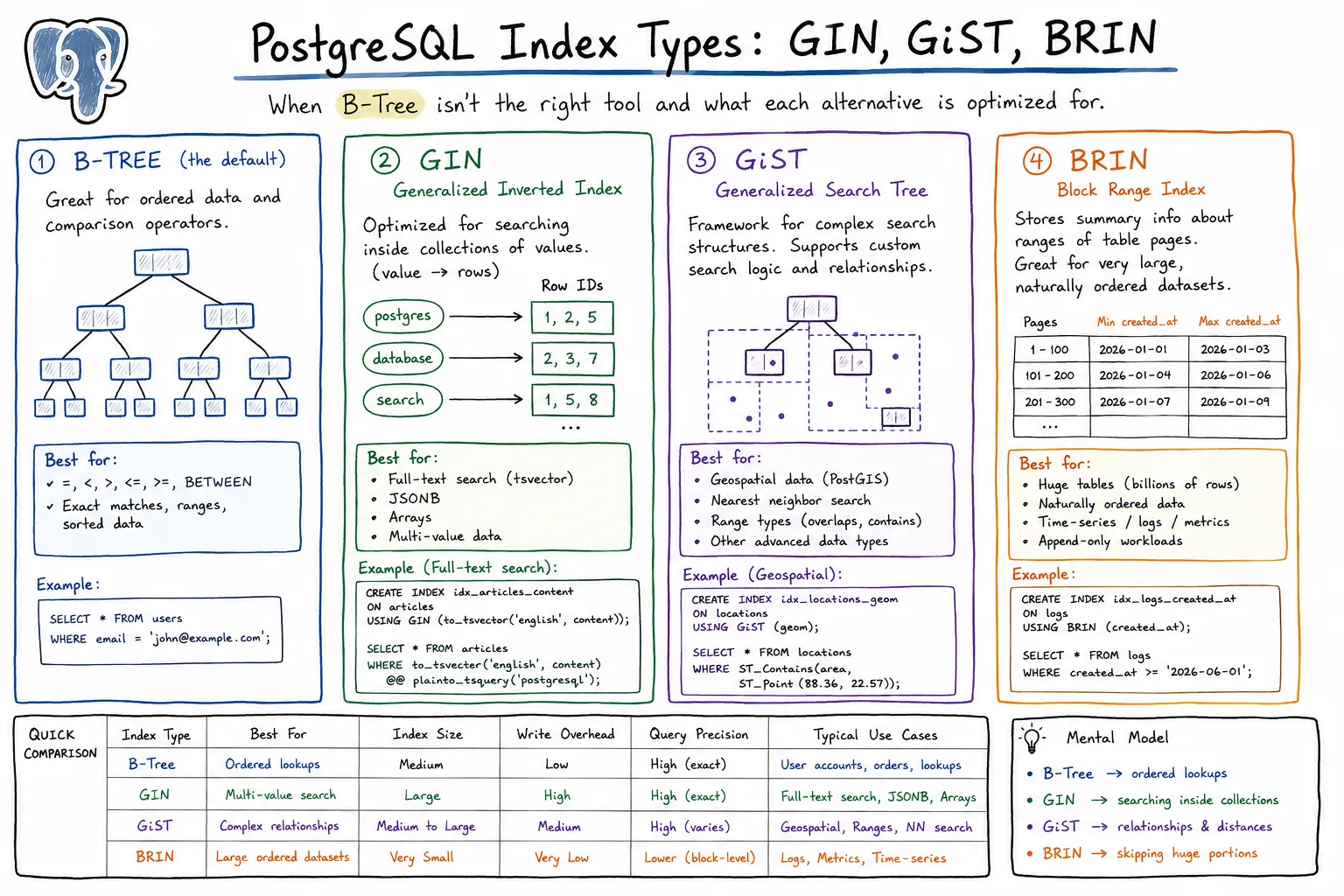
Most developers learn B-Tree indexes first, and for good reason, they solve a huge percentage of query performance problems. However, not every query pattern fits neatly into a B-Tree structure. Workloads involving full-text search, geospatial data, JSON documents, or massive time-series datasets often require specialized indexing strategies to achieve optimal performance.
PostgreSQL provides several specialized index types designed for specific workloads. Understanding when to use them can turn a slow query into a millisecond lookup while keeping storage and maintenance costs under control.
Why B-Tree Isn’t Always Enough
A B-Tree index works exceptionally well for ordered data and comparison operators such as:
=<><=>=BETWEEN
For example:
SELECT *
FROM users
WHERE email = 'john@example.com';
A B-Tree index on email is perfect here because PostgreSQL can efficiently navigate the tree structure and find the matching row.
The problem appears when the query pattern doesn’t fit an ordered lookup model. Consider:
SELECT *
FROM articles
WHERE to_tsvector(content) @@ plainto_tsquery('postgres');
Or:
SELECT *
FROM locations
WHERE ST_DWithin(
    coordinates,
    ST_Point(88.36, 22.57),
    1000
);
Or even:
SELECT *
FROM sensor_readings
WHERE created_at BETWEEN
    '2026-01-01'
    AND '2026-01-02';
against a table containing billions of rows.
These workloads need different indexing strategies.
Choosing the right index type is often more important than adding more hardware.
GIN Index
GIN (Generalized Inverted Index) is designed for situations where a single row contains multiple searchable values.
Think of it as creating a reverse lookup table.
Instead of:
row → valuesGIN stores:
value → rowsThis makes it extremely efficient for searching collections of values.
Full-Text Search
A common use case is PostgreSQL full-text search.
CREATE INDEX idx_articles_content
ON articles
USING GIN (
    to_tsvector('english', content)
);
Query:
SELECT *
FROM articles
WHERE to_tsvector('english', content)
@@ plainto_tsquery('postgresql');
Without GIN, PostgreSQL would scan every row.
With GIN, PostgreSQL can directly find documents containing matching terms.
JSONB Search
GIN is also widely used with JSONB.
CREATE INDEX idx_products_metadata
ON products
USING GIN(metadata);
Query:
SELECT *
FROM products
WHERE metadata @>
'{"category":"electronics"}';
This pattern is common in modern applications where product attributes or user preferences are stored as JSON.
Array Operations
GIN also performs well for array searches.
CREATE INDEX idx_user_tags
ON users
USING GIN(tags);
Query:
SELECT *
FROM users
WHERE tags @> ARRAY['backend'];
Trade-Offs
Advantages:
- Extremely fast lookups for composite values
- Excellent for full-text search
- Works well with arrays and JSONB
- Common choice for search-heavy systems
Disadvantages:
- Larger index size
- Slower writes and updates
- More maintenance overhead
GiST Index
GiST (Generalized Search Tree) is PostgreSQL’s framework for complex search structures.
Unlike B-Tree, GiST doesn’t assume data has a simple ordered relationship.
Instead, it allows PostgreSQL extensions to define custom search behavior.
Geospatial Queries
The most common GiST use case is spatial data through PostGIS.
CREATE INDEX idx_locations_geom
ON locations
USING GiST(geom);
Query:
SELECT *
FROM locations
WHERE ST_Contains(
    area,
    ST_Point(88.36,22.57)
);
Finding all locations inside a geographic boundary becomes dramatically faster.
Without GiST, PostgreSQL may need to evaluate every geometry object in the table.
A common misconception is that GiST itself uses Google’s S2 geometry algorithm internally. PostgreSQL’s GiST index does not directly implement Google’s S2 library. Instead, PostGIS typically uses spatial indexing strategies based on bounding boxes and tree structures built on top of the GiST framework. However, conceptually both approaches aim to reduce the search space by organizing geographic objects hierarchically so that large portions of data can be skipped during spatial searches.
Nearest Neighbor Search
GiST supports proximity-based queries.
Example:
SELECT *
FROM locations
ORDER BY geom <-> ST_Point(88.36,22.57)
LIMIT 10;
This returns the nearest locations efficiently.
The ability to support “distance” operations makes GiST ideal for mapping applications, ride-sharing platforms, delivery systems, and logistics software.
Range Types
GiST also works with PostgreSQL range data types.
CREATE INDEX idx_booking_range
ON bookings
USING GiST(time_slot);
Query:
SELECT *
FROM bookings
WHERE time_slot &&
      tstzrange(
        NOW(),
        NOW() + interval '1 hour'
      );
This helps detect overlapping bookings efficiently.
Trade-Offs
Advantages:
- Excellent for geospatial data
- Supports nearest-neighbor searches
- Useful for range overlap queries
- Highly flexible indexing framework
Disadvantages:
- More complex internally
- Slower than B-Tree for simple equality lookups
- Additional extension support may be required
BRIN Index
BRIN (Block Range Index) takes a completely different approach.
Instead of indexing every row, BRIN stores summary information about groups of table pages.
A BRIN index might store metadata such as:
Pages 1-100:
Min timestamp = Jan 1
Max timestamp = Jan 3

Pages 101-200:
Min timestamp = Jan 4
Max timestamp = Jan 6
When PostgreSQL receives a query, it can skip large portions of the table immediately.
Why BRIN Exists
Imagine a logging table:
CREATE TABLE logs (
    id BIGSERIAL,
    created_at TIMESTAMP,
    message TEXT
);
Rows are inserted chronologically.
A query such as:
SELECT *
FROM logs
WHERE created_at >=
      '2026-06-01';
only needs recent data.
Because timestamps naturally correlate with physical row placement, BRIN can quickly eliminate older storage blocks.
Creating a BRIN Index
CREATE INDEX idx_logs_created_at
ON logs
USING BRIN(created_at);
The index remains tiny even when the table contains billions of rows.
I’ve seen BRIN indexes measured in megabytes while equivalent B-Tree indexes consumed gigabytes.
When BRIN Works Best
BRIN shines when:
- Tables are extremely large
- Data is naturally ordered
- Insert patterns follow time progression
- Storage efficiency matters
Examples include:
- Event logs
- Metrics platforms
- Clickstream data
- IoT sensor readings
- Audit trails
Trade-Offs
Advantages:
- Very small index size
- Minimal maintenance cost
- Fast range filtering on huge datasets
- Ideal for append-only workloads
Disadvantages:
- Less precise than B-Tree
- May still scan blocks after filtering
- Poor performance when data is randomly distributed
Comparing GIN, GiST, and BRIN
| Index Type | Best For | Typical Use Cases |
|---|---|---|
| GIN | Multi-value search | Full-text search, JSONB, Arrays |
| GiST | Complex search structures | Geospatial, Range Types, Nearest Neighbor |
| BRIN | Massive ordered datasets | Logs, Metrics, Time-Series Data |
A useful mental model:
- B-Tree → ordered lookups
- GIN → searching inside collections
- GiST → searching relationships and distances
- BRIN → skipping huge portions of large tables
How I Choose in Real Systems
When designing a schema, I start by analyzing query patterns rather than table structures.
If users search documents, I immediately think about GIN.
If the application deals with maps, routes, locations, or geometric relationships, GiST becomes the default choice.
For massive append-only datasets where rows naturally follow time order, BRIN is often the most cost-effective option.
PostgreSQL provides specialized index types because different workloads require different access strategies. Choosing the correct one can reduce query latency from seconds to milliseconds while consuming a fraction of the storage.
The best index is not the most powerful one, it’s the one that matches the way your data is actually queried.